

Did you know 40% of food is wasted?
Why almonds’ uber-long shelf life matters.
America throws away nearly 60 million tons of food every year. That’s almost 40% of the entire U.S food supply,1 not to mention all of the resources that went into growing that food. While the numbers vary a bit from country to country, it’s a problem around the globe with food lost or wasted on the farm, in transport, at retail and in our homes.
California’s Natural Advantage
An impact that resonates
Almonds are an exception in this space with their 2+ year shelf life. That means less than 1% are thrown out in the home,2 the lowest of any U.S. food, and even fewer in the supply chain. What’s more, almonds grow inside of a hull and a shell, both of which are put to good use after the nuts are harvested. More on that below.
Another plus of that long shelf life? Almonds are perfectly suited for travel by boat — no need for airplanes here! Transportation via cargo ships has the lowest carbon emissions of common food transport methods, producing 50 times less carbon dioxide emissions per kilometer than travel by airplane.3a felis a diam interdum vestibulum sit amet eget odio.
Check our 5 min video!
Nature’s carbon sink.
Almond trees capture and store carbon dioxide, a greenhouse gas, in their wood and roots. Compared to other fruit and nut trees grown in California, almonds store one of the highest amounts of carbon per acre – 18 metric tons of carbon per acre per year.1
Can farming fight climate change?
You bet. From planting trees to regenerative farming, almonds are part of the solution.
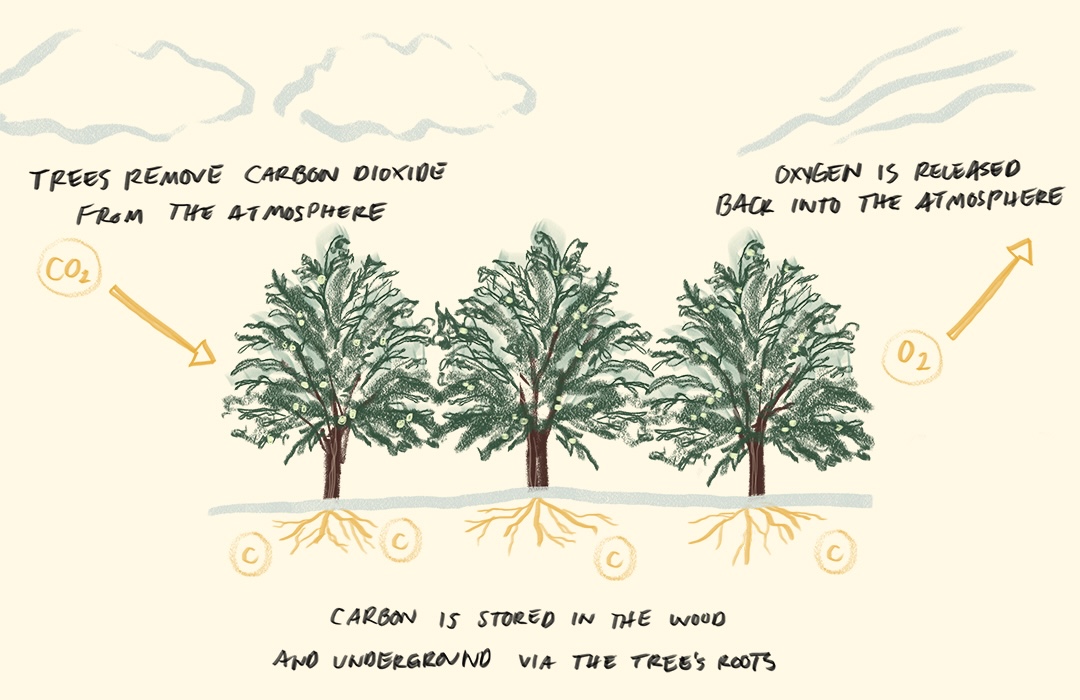
When you look at carbon stored in all of California’s almond trees (1.63 million acres) it nets out to 30 million metric tons.1 That’s the same as you would save from a year of any one of the following:
— taking 24 million cars off the road2 (the same number of cars driven in CA, OR, WA, and TX)
— grounding 3,134 Boeing 737s3 (approximately the fleet size of the world’s top 4 airlines)
— shutting down 29 coal fired power plants2
These agricultural forests and the carbon they capture are also an important part of how California will achieve its greenhouse gas reduction goals and climate change mitigation plans.